Tashkent's Water Diplomacy: From National Reforms to Regional Synergy in Central Asia
The upcoming meeting of the Heads of the Founding States acquires special significance, as it marks the transition of the Fund's chairmanship to Uzbekistan for 2027–2029 period. This will be our country’s third mandate, following leadership terms in 1997–1999 and 2013–2016.
It is worth noting that Tashkent was at the forefront of the creation of IFAS. Yet, resuming this leadership role after a decade takes place in a fundamentally transformed regional landscape. Today, Uzbekistan offers not only significant expertise but also a comprehensive portfolio of realized initiatives that are globally recognized.
The Transformation of Uzbekistan's Water Sector for Sustainable Development
Facing intensified climate pressures alongside robust economic and demographic growth, Uzbekistan has committed to a fundamental restructuring of its water resource management, elevating it to a core priority of state policy.
The complexity of the situation is underscored by objective data. Over the last 15 years, per capita water availability in the republic has decreased by more than half – falling from 3,000 to 1,400 cubic meters per year. According to the Ministry of Water Resources, the annual volume of water resources has dropped to 51–53 billion cubic meters, representing a 21% decline from 1991 levels (64 billion cubic meters).
A significant challenge remains the high dependence on external sources, as approximately 80% of surface water (41 billion cubic meters) originates outside the country. While the water shortage did not exceed 3 billion cubic meters prior to 2015, expert forecasts indicate that the deficit could reach 7 billion by 2030 and 15 billion cubic meters by 2050.
Recognizing the scale of these risks, Uzbekistan – under the leadership of Shavkat Mirziyoyev – is undertaking a comprehensive technological modernization of the water sector. In less than a decade, the land area utilizing water-saving technologies has surged from 28,000 hectares to over 2.6 million hectares, now covering more than 60% of all irrigated land. Parallel to these efforts, large-scale work is being carried out across the country on the concreting of canals and the reconstruction of flume networks. It is projected that by 2030, these systemic measures will yield annual savings of up to 15 billion cubic meters of water.
Along with this, the digitalization of the industry is being carried out. Currently, 11 information platforms are being deployed to manage the water cadastre, monitor pumping stations, and track land reclamation status. Over the past four years, the management of 100 major water facilities has been fully automated, the “Smart Water” system has been introduced at 13,000 water intake points, and more than 1,700 pumping stations have been equipped with real-time online monitoring devices.
Simultaneously, the national economic model is undergoing a strategic adaptation. According to the Center for Economic Research and Reforms, the share of agriculture in the GDP structure has steadily decreased from 32% in 2017 to 19% by 2024. Notably, against this backdrop, the total volume of agricultural production has increased by 17%. This divergence confirms a successful transition toward more rational, efficient resource utilization and higher productivity.
Regional Synergy and Water Diplomacy
At the same time, Uzbekistan has achieved significant results on the international water cooperation track. Most of the initiatives proposed by Tashkent within the framework of IFAS have been successfully implemented thanks to the consolidation of regional efforts and the active support of international partners.
The primary vector of this work has been the large-scale ecological rehabilitation of the Aral Sea region. A network of local water bodies was created on the dried bottom of the sea and in the Amu Darya delta, including the Sudochye, Khojakul-Karajar, Maipost-Domalak lake systems, the Mezhdurechenskoe reservoir, as well as the Muynak, Rybachy, and Zhyltyrbas bays.
In addition, colossal forest reclamation projects are underway. To date, green plantations have been established across approximately 2 million hectares. In the next two years, it is planned to create protective belts on another 400 thousand hectares. The expansion of the protected natural area network – which has now reached 4.6 million hectares in the Aral Sea region – has not only significantly reduced the emission of toxic dust but has also created the necessary conditions for the revival of local flora and fauna.
International recognition of these efforts was solidified in 2019 at a high-level conference in Nukus, where the designation of the Aral Sea region as a 'Zone of Ecological Innovations and Technologies' was established. This initiative, first proposed by President Shavkat Mirziyoyev at the 72nd session of the UN General Assembly and the IFAS Summit in 2018, received universal support in 2021 when the UN General Assembly unanimously adopted the corresponding Resolution.
An important addition to political initiatives was the launch in 2018 of the UN Multi-Partner Trust Fund for Human Security for the Aral Sea Region. Established at the proposal of Uzbekistan, the Fund serves as an effective mechanism for mobilizing donor resources and coordinating international efforts to address the region’s most pressing socio-economic and environmental challenges.
Along with the development of such instruments of financial and humanitarian assistance, Uzbekistan invariably views IFAS as the " preeminent platform for regional interaction in the water and environmental sphere," playing a unique role in ensuring the stability of Central Asia. Through the qualitative strengthening of this Organization, Tashkent intends to further promote the consolidated interests of the entire region on the global stage.
Furthermore, Uzbekistan has achieved a diplomatic breakthrough by spearheading multilateral cooperation formats. A steadfast commitment to the principles of good-neighborliness and proactivity have paved the way for a constructive dialogue on the joint management of the Amu Darya and Syr Darya water resources.
Concrete examples of this synergy include the agreements between Uzbekistan, Kazakhstan, and Tajikistan on the operation of the 'Bahri Tojik' reservoir, as well as the landmark decisions by Uzbekistan, Kazakhstan, and Kyrgyzstan regarding the Toktogul reservoir and the 'Kambarata-1' HPP construction project.
In light of the growing water shortage, a logical continuation of these efforts is a transition toward long-term strategic planning. To this end, during the Seventh Consultative Meeting of the Heads of State, the President of Uzbekistan proposed declaring 2026–2036 as the 'Decade of Practical Actions for the Rational Use of Water in Central Asia.' Recognizing that effective management is unattainable without a highly skilled workforce, Tashkent also plans to establish a Regional Center of Competence in Water Management at the 'TIIAME' National Research University."
A critical vector of regional water cooperation remains the establishment of a dialogue with Afghanistan. Uzbekistan advocates for the gradual involvement of Kabul in regional partnership on the basis of a balance of interests. As practical steps, Tashkent proposes conducting joint monitoring of transboundary rivers, the real-time exchange of hydrometeorological data, and the creation of permanent expert platforms. These measures are intended to lay the foundation for fair and rational water use throughout the region.
In summary, large-scale internal reforms combined with a proactive foreign policy have created a solid foundation for the upcoming chairmanship of Uzbekistan in IFAS. During its mandate in 2027–2029, the State intends to prioritize the comprehensive renewal of the regulatory and institutional framework of the Fund. At the same time, effort will remain focused on enhancing socio-economic conditions, strengthening ecological safeguards, and identifying sustainable ways to increase the water supply of the region. Ultimately, Tashkent aims to elevate the international standing of IFAS, transforming water and ecological cooperation into a cornerstone of sustainable development and a guarantor of long-term stability for all nations of Central Asia.
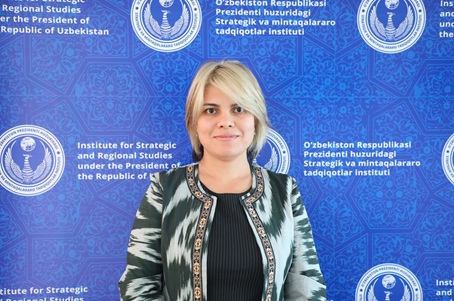
Lobar Umarova
Senior Research Fellow at the Institute for Strategic and Regional Studies under the President of the Republic of Uzbekistan


