Large-scale capacities have been commissioned and construction of a number of new energy facilities has begun in Uzbekistan.
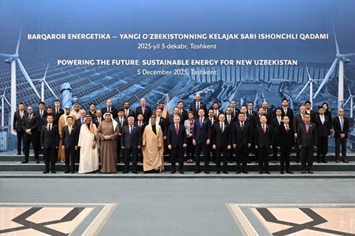
The event was attended by Suhail Al Mazrouei, Minister of Energy and Infrastructure of the United Arab Emirates; Alparslan Bayraktar, Minister of Energy and Natural Resources of the Republic of Turkey; Parviz Shahbazov, Minister of Energy of the Republic of Azerbaijan; Taalaibek Ibrayev, Minister of Energy of the Kyrgyz Republic; and representatives of the World Bank, the European Bank for Reconstruction and Development, the Asian Development Bank, the Asian Infrastructure Investment Bank, the Islamic Development Bank, and leading companies ACWA Power (Saudi Arabia), Aksa Enerji, Cengiz Enerji (Turkey), Masdar (UAE), China Energy, Datang, Sinoma, Poly (China), EDF, Voltalia, TotalEnergies (France), Siemens Energy (Germany), and Nebras Power (Qatar).
The new facilities—42 new generation, storage, and production facilities, along with other energy infrastructure worth $11 billion—are part of a large-scale strategy being implemented in our country aimed at strengthening the national energy potential.
These include 16 solar, wind, thermal, and hydroelectric power plants with a total cost of $3.3 billion and a capacity of 3,500 megawatts in Karakalpakstan and the Bukhara, Kashkadarya, and Tashkent regions.
When fully operational, they will produce 15 billion kilowatt-hours of electricity annually.
As a result, next year, the volume of green energy generated in the country will reach 23 billion kilowatt-hours. This will fully meet the annual electricity needs of the population of Uzbekistan.
Most importantly, clean energy will help reduce natural gas consumption by almost 7 billion cubic meters. This will prevent the emission of 11 million tons of harmful substances into the atmosphere.
Among the projects being launched are 10 energy storage systems with a total capacity of 1,245 megawatts. This will allow an additional 1.5 billion kilowatt-hours of electricity to be supplied to the grid during peak loads.
An additional 11 large substations and 420 kilometers of high-voltage networks are being commissioned, which will contribute to the stable operation of the power grid.
The new enterprises of Angren Energo, producing 15,000 transformers annually, and Uzhydropower, manufacturing 155 hydroelectric units annually, will make a significant contribution to the economy.
Speaking at the ceremony, the head of state expressed confidence that this important event will be another practical step towards Uzbekistan's sustainable development.
"Considering the rapid economic growth and the growing needs of the population, we are implementing large-scale reforms in the energy sector. We have identified two key goals in this area. The first is to ensure a reliable and uninterrupted power supply to all industries and regions. The second is to achieve this goal primarily through modern, environmentally friendly, and renewable energy sources," the President stated.
It was noted that in recent years, $35 billion in foreign investment has been attracted to the energy sector, and 9,000 megawatts of new capacity has been commissioned.
As a result, electricity production increased from 60 billion kilowatt-hours in 2017 to 85 billion this year.
It is particularly significant that solar and wind power plants with a combined capacity of approximately 5,000 megawatts, as well as hydroelectric power plants with a capacity of 400 megawatts, have been launched. The share of "green" energy in total generation will reach 30 percent this year.
Furthermore, 2,000 megawatts of small solar panels have been installed in the private sector, in households, and at public facilities. This year alone, they have generated nearly 2 billion kilowatt-hours of additional renewable energy. Across the country, 69,000 kilometers of power grids, 14,000 transformer stations, and high-voltage substations have been upgraded.
These transformations provide a powerful impetus to the development of domestic enterprises. Since the beginning of the year, local manufacturers have supplied construction materials, metal structures, cable products, and electrical equipment for power plants and networks under construction, as well as provided design, engineering, and construction services worth $700 million.
For example, the first hydroelectric power station of the Naryn Cascade, with a capacity of 38 megawatts, was commissioned entirely using domestic equipment and materials.
The leader of Uzbekistan emphasized that foreign investors and international partners are largely responsible for these achievements and successes.
The head of state stated that over the next five years, thousands of industrial and infrastructure facilities are planned to be commissioned, and numerous high-quality buildings are to be built, thanks to over $150 billion in foreign investment.
paid jobs.
To create an attractive environment for companies working in emerging areas such as IT, artificial intelligence, and the Internet of Things, the creation of supercomputer clusters and data centers is planned.
In this context, the Saudi Arabian company DataVolt has already begun implementing a project to build a 500-megawatt data center with an investment of $3 billion.
The implementation of such large-scale projects will significantly increase electricity demand—at least 1.5 times. In this context, the President of our country discussed further plans for energy development.
First, to meet growing electricity demand, more than 17,000 megawatts of renewable energy capacity will be commissioned by 2030. As a result, the share of "green" energy in total generation will increase to 54 percent.
To integrate the new capacity into the unified power grid, 6,000 kilometers of high-voltage transmission lines will be built. As early as next year, 1,000 kilometers of such lines will be laid and substations with a capacity of 6,000 megawatts will be built.
Secondly, increasing the attraction of foreign investment through public-private partnerships. Starting this year, private partnership principles will be applied not only to electricity production but also to its supply.
In particular, an agreement has been reached with the Turkish company Aksa Elektrik to transfer the management of the regional power grids in Samarkand to private ownership.
The company will assume operational management of the grid, invest in modernization, and halve losses, resulting in annual savings of an average of $20 million.
Similarly, next year, investors will be offered the opportunity to manage the power grids of the Jizzakh and Syrdarya regions, and in 2027, those of Namangan and Tashkent.
Third, active support for the transition to alternative energy sources.
This year, solar power plants with a total capacity of 107 megawatts will be installed in 300 mahallas (neighborhoods) through cooperative arrangements. This social initiative will provide green energy to 30,000 low-income families, who will be able to transmit surplus energy to the grid and generate additional income.
This year, entrepreneurs built 40 megawatts of small and micro hydropower plants. As a result, 120 million kilowatt-hours of electricity were generated, and the entrepreneurs themselves received a new source of income.
Next year, another 65 megawatts of small and micro hydropower plants will be built, significantly improving the electricity supply to 80,000 households.
Fourth, at the COP30 climate conference held in Brazil, Uzbekistan made an important commitment under the Paris Agreement to reduce greenhouse gas emissions by 50 percent by 2035.
In collaboration with the World Bank, the innovative iCRAFT project was launched for the first time, accounting for 23 million tons of greenhouse gas emissions reduced by Uzbekistan. A system for selling carbon units has been launched on the international market.
It is important to note that this year alone, 17 large industrial enterprises have transitioned to the international green energy certification system. Over the next two years, the number of such enterprises will increase to 100.
Fifth, developing partnerships with neighboring countries to create a unified energy market.
Next year, financing for the Kambarata-1 HPP project will begin jointly with Kyrgyzstan and Kazakhstan to ensure the efficient and shared use of the region's hydropower potential.
The head of state also particularly noted the determined efforts of the leadership of Azerbaijan and Kazakhstan in creating a green corridor for electricity exports to Europe.
"All the projects we are launching today will become a source of sustainable economic growth and open up new opportunities for future generations. Thanks to such purposeful steps, we will undoubtedly create a modern, new type of energy system," the leader of our country noted.
Finally, by flipping a switch, the President of Uzbekistan launched 42 energy facilities and the construction of 21 new projects.
President
Shavkat Mirziyoyev


